Academic profile
Research, publications and teaching
I am a media theorist and practitioner working on computational photography, algorithmic visuality and the visual documentation of cultural heritage. My research asks how imaging technologies such as photogrammetry, machine vision and interactive systems reshape visual language, perception and mediation. It moves between critical writing and practice-based inquiry, from image theory to fieldwork at heritage sites in Jerusalem and Cyprus.
Media theoryComputational photographyCultural heritage documentationPhotogrammetry and 3D modelingInteractive installations and mixed realityAlgorithmic technologies and user interaction
Download CV (PDF)PublicationsORCID profileContact
Profile pages: Jerusalem Multidisciplinary College | DINÂMIA’CET, Iscte | Jerusalem Institute for Research and Digital Documentation of Cultural Heritage | The Hebrew University of Jerusalem
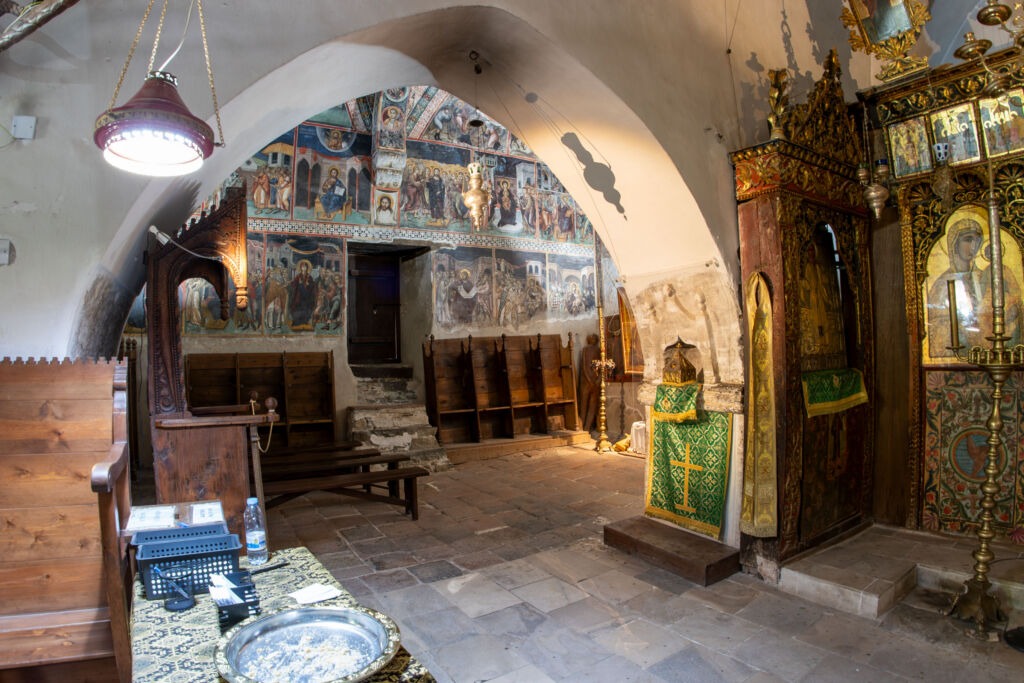
Painted interior, Monastery of Saint John Lampadistis, Troodos, Cyprus
12
peer-reviewed publications in journals and proceedings
20+
conference papers across Europe since 2014
3
invited lectures in Lisbon, Venice and Nicosia
5
countries of invited lectures and visiting teaching: Portugal, Italy, Spain, Cyprus and India
Academic appointments
Since 2026
Associate Researcher, Cities and Territories Research Group
Since 2024
Director, Department of Photographic Communications
Jerusalem Multidisciplinary College (formerly Hadassah Academic College)
Since 2022
Senior Researcher
Jerusalem Institute for Research and Digital Documentation of Cultural Heritage
2010 to 2024
Senior Lecturer, Department of Photographic Communications
2014 to 2021
Lecturer, M.Des program
Bezalel Academy of Art and Design, Jerusalem
Education
2022
PhD, Department of Communication and Journalism
The Hebrew University of Jerusalem
Thesis: The Visual Algorithm
2004
MPS, Interactive Telecommunications Program
Tisch School of the Arts, New York University
Thesis: The Angel of History
1997
BFA, Department of Photography
Bezalel Academy of Art and Design, Jerusalem
Thesis: A Visit to the Mountain
Selected publications
2026 | Frontiers in Education
Linear or grid? LMS layout and students’ perceived usability across academic progression
Nathan, D., Altaratz, D., Rozen, S., Fenakel Fiedelman, M. and Gertner Moryossef, I.
Frontiers in Education 11, 1896137.
Read more
Learning management systems (LMS) are the central digital environments of higher education, yet decisions about their interface layout are often guided by institutional defaults rather than empirical evidence. This quasi-experimental study compared two widely used Moodle layouts, the linear collapsed topics format and the tile-based grid format, in a mandatory institutional course evaluated by 386 undergraduate students. Students using the linear layout assigned significantly higher user-experience and user-interface scores, and third-year students rated usability higher than first-year students, while the layout effect remained broadly consistent across academic years, gender and discipline. The study frames LMS interface preferences as emerging from the interplay between interface structure and learners’ accumulated experience, positioning interface design as a pedagogical decision rather than a merely technical one.
2026 | Urban Surfaces Research Network
Urban Surfaces Research Network, Vol. 7
Andron, S., Avramidis, K. and Ward, T. (eds.), with contributions by the workshop participants, including D. Altaratz
Melbourne Centre for Cities, University of Melbourne.
Read more
Open-access booklet from the seventh international workshop of the Urban Surfaces Research Network (online, April 21, 2026), an interdisciplinary network of scholars and practitioners who study urban surfaces as spaces of communication, governance and political contestation.
2026 | New Media & Society
Witnessing carnage: Self-documented terrorism and the moral challenges of decentralized digital platforms
Morse, T. and Altaratz, D.
New Media & Society 28(4), 1524-1549.
Read more
On October 7, 2023, Hamas launched a coordinated attack on Israel, documenting atrocities through wearable cameras and disseminating footage on platforms like Telegram. This article investigates how these self-documented acts exemplify the erosion of traditional distinctions between perpetrators and mediators of representations of violence. Using point-of-view (POV) aesthetics and leveraging decentralized digital platforms, Hamas transformed violence into a mediated spectacle, dehumanizing victims and gamifying terrorism. The study critically unpacks these strategies, highlighting their role in bypassing journalistic filters to spread fear and achieve ideological objectives. The article further examines the ethical and societal challenges posed by this new ecology of media, where platforms act as sites of violence, and witnessing becomes intertwined with participation. By analyzing the events of October 7, this work contributes to understanding the complexities of mediated violence, exploring how end-users recontextualize and circulate graphic content, shaping new forms of media witnessing and engagement with political violence.
2024 | Philosophy of Photography
The uncanniness of interactive photography: Exploring spatial perception in virtual tours and structure from motion
Altaratz, D.
Philosophy of Photography 15.
Read more
Photography has always been associated with the physical activity of the human body: capturing, editing and viewing photos are all activities that involve the user’s spatial interaction with the technology used. With conventional photography, one aspect of spatial relation with technology is the viewer’s ability to recognize the camera’s location in the photographic scene through visual indications, such as the relative location of objects in the frame to the camera’s point of view, combined with a basic familiarity with the functionality of conventional cameras, relating to the notions of ‘in-front’ and ‘behind’ the camera. Some instances of interactive photography, such as 360-degree imagery and three-dimensional photogrammetry, challenge the spatial connection between the photographer (represented by the camera location) and the viewer due to unique usability and innovative interactions, such as the viewer’s ability to ‘move’ freely in all directions of the three-dimensional, photographic space. The technological affordances of interactive photography create a distinct corporeal experience that challenges the traditional associations between the photographer, the viewer and the photographic imagery, evoking with the viewers the notion of technological uncanniness and, consequently, questioning some of the traditional preconceptions regarding the prime characteristics of the photographic medium.
2023 | Social Sciences
Digital Séance: Fabricated encounters with the dead
Altaratz, D. and Morse, T.
Social Sciences 12(11), 635.
Read more
Digital afterlife is becoming increasingly possible due to advancements in VR, deepfake, and AI technologies. The use of computational photography for mourning and commemoration has been re-integrated into practices of remembrance, farewell, continuity, and disengagement. Two case studies, the Shoah Foundation’s Dimensions in Testimony and the TV production Meeting You, are analyzed to explore these new possibilities. We show how photography’s new affordances enable interaction while maintaining its essence as a representation of reality and argue that this socio-technological transformation habituates contemporary practices of mourning and commemoration, adjusting images to serve the individual needs and interests of the bereaved and the community.
2023 | Sustainability
Historic graffiti as a visual medium for the sustainable development of the underground built heritage
Trentin, M. G., Altaratz, D., Caine, M., Re’em, A., Tinazzo, A. and Gasanova, S.
Sustainability 15(15), 11697.
Read more
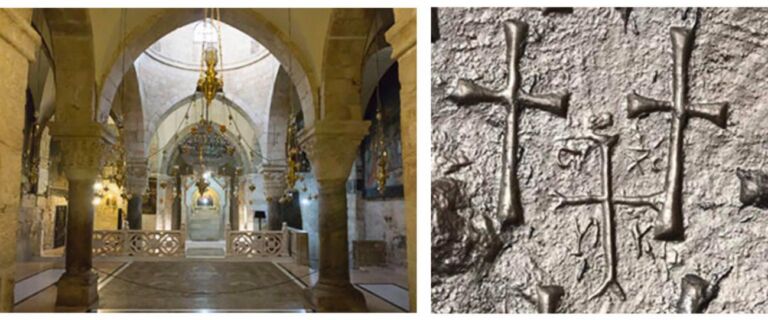
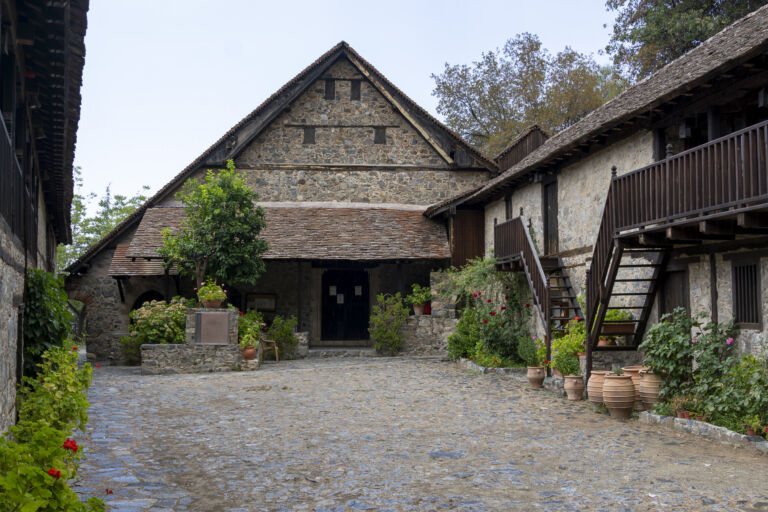
Since prehistoric times, graffiti has been a way for humans to express themselves and interact with the landscape in a visual way. Graffiti is a visual record of the relationship between society, culture, and the environment over time, representing an additional layer of sociocultural value to the underground built heritage (UBH). Thanks to the application of digital technologies and a specific workflow, this paper will suggest how graffiti can be regarded as an additional and relevant element of creating connections and strengthening the site’s values, bridging the past and present communities. Through the critical discussion of two case studies, the monastery of Ayia Napa (Cyprus) and the Saint Helena chapel in the Holy Sepulchre in Jerusalem, the authors want to achieve two main goals: first, they want to highlight the sociocultural value and raise awareness about the presence and significance of historic graffiti. In the second instance, they wish to illustrate how graffiti can be an additional agent for the sustainable development, valorization, and promotion of the UBH.
2023 | photographies
The human tripod: Computational photography, automated processes, and professional identity
Altaratz, D.
photographies 16(2), 291-311.
Read more
How can professional photography continue to exist in an age of machine vision? As this article suggests, computational photography destabilizes the ideology of professional photographic distinctiveness, expertise, agency and creativity. In an era characterized by constant instability due to technological developments, changes to photographer’s professional habitus are expected. While these changes are connected to technical modifications in professional tools, they can deeply challenge the identities of practitioners, their perception of photography’s fluctuating affordances, their own roles in image-production, and even the distinctiveness of the medium itself. Professional photography is thus a powerful signifier of the photographic medium and a key arena for understanding the social meaning of the automation of vision across the entire photographic field. Drawing upon interviews with professional photographers who use Structure from Motion, this article propose a new emerging professional identity adapted to this situation: ‘the computational photographer’. For such a photographer the automation of photographic processes necessitates a shift in the site of identity-construction and expertise, away from image-production itself and toward the sphere of distribution on professionally oriented digital platforms. I argue that the advent of the ‘computational photographer’ indicates that automation processes and practices of technological embodiment influence the habitus of professional photographers.
2022 | Archaeology of Jerusalem
Historical archaeology of medieval pilgrimage: Dating the “Walls of the Crosses” in the Holy Sepulchre Chapel of St. Helena
Re’em, A., Caine, M., Altaratz, D. and Tchekhanovets, Y.
New Studies in the Archaeology of Jerusalem and Its Region 15.
Read more
The article addresses the dating of the thousands of crosses incised on the walls of the Chapel of Saint Helena in the Church of the Holy Sepulchre, the so-called Walls of the Crosses, combining historical sources, archaeological analysis and advanced imaging of the incisions.
2021 | photographies
Sentient photography: Image-production and the smartphone camera
Altaratz, D. and Frosh, P.
photographies 14(2), 243-264.
Read more
Thanks to the smartphone, photography has become pervasive in contemporary digital culture. Yet the smartphone’s very ‘smartness’ profoundly alters the relations of control between humans and technologies in image-production practices. Unlike dedicated cameras, smartphones use built-in sensors for small-scale positioning to ‘sense’ user’s bodily orientations and states of motion. Combined with photographic applications, this ‘sentience’ enables devices to direct user actions and to require user compliance in order to create an image. In this paper, we analyze image-production in three smartphone applications to chart a continuum between two techno-cultural poles. At one pole smartphone photography accommodates a range of human-technological interactions, including the development of new forms of play and experimentation. At the opposite pole, it executes algorithmically-choreographed sentient photography in which ultimate decisions are made by context-aware learning software, radically reconfiguring the distribution of agency between humans and technologies. The development of sentient photography, we conclude, represents the integration of the photographer’s body itself into platform control of image-production.
2020 | EVA London
The spirit of the cloud: The “New Jerusalem” as a metaphor for social experiences of virtual technologies
Caine, M., Altaratz, D., Mann, E. and Havkin, A.
Proceedings of EVA London 2020, 58-65.
Read more
Over the past centuries, the city of Jerusalem has been a center for social and spiritual experiences of diverse communities separated from their homes and cultures. The crusaders notion of a ‘New Jerusalem’; the physical reconstruction of the holy city of Jerusalem in Europe has been reversed and implemented through remote communities who moved to Jerusalem from overseas and reconstructed their home and places of worship. This project aims to express and enhance the dialectical relationship between diverse geographical locations, manifested through lost and reborn communities, the old and the New Jerusalem. Two very different, yet historically linked test cases are explored: The reconstructed Synagogue of the lost community of Conegliano Veneto, Italy, and the Kidane Mehret Ethiopian Church. Both located today in Jerusalem. Through the use of advanced photogrammetry, we attempt to create an emotional experience, transcending time and space and intensifying the complex experience of life in a home away from home. The two structures are recreated as 3D point clouds, enhanced by sounds of prayer and blended with historical imagery. The paper outlines the considerations, limitations, and solutions undertaken in the digital recreation of the structures. Likewise, it explores the process of fusing the technical challenge with the desired emotional impact on the user.
2019 | EVA Florence
Combining RTI and SFM: A multi-faceted approach to inscription analysis
Caine, M., Altaratz, D. and Maggen, M.
Proceedings of EVA Florence 2019, 97-104. Firenze University Press.
Read more
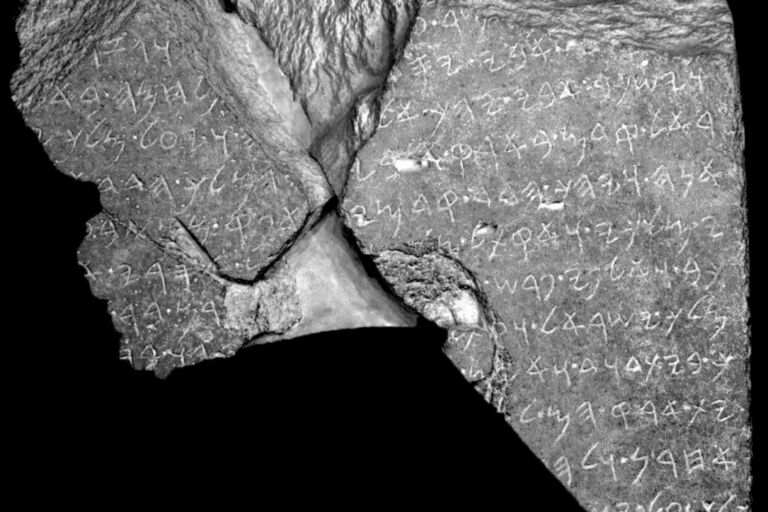
This paper describes an approach of employing a dual heritage imaging process in an attempt to overcome the inherent challenges of inscription analysis and surface texture information in several different situations. In the cases presented, we have employed a hybrid approach, cross-referencing traditional archaeological research with close-range 3D Structure from Motion (SFM) imaging and Reflectance Transformation Imaging (RTI). As will be demonstrated, it is our opinion that in the circumstances such as these, there is not one dominant technology, but rather, a combination of complementing strengths, which can aid in unlocking the secrets of the engravings and inscriptions.
2018 | EVA London
The riddle of the crosses: The Crusaders in the Holy Sepulchre
Caine, M., Altaratz, D., MacDonald, L. and Re’em, A.
Proceedings of EVA London 2018, 132-139.
Read more
This paper describes the rationale, the challenges and the imaging solutions employed in an attempt to uncover a centuries-old riddle. We suggest an answer to the meaning of the thousands of crosses, symbols, and texts, inscribed on the walls and behind the altar of the Chapel of Saint Helena, within the Church of The Holy Sepulchre in Jerusalem, ascribed to Crusaders of the 12th and 13th centuries. A variety of photographic and photogrammetric imaging technologies have been utilized, along with traditional archaeological research, in an intensive attempt to document as much empirical data as possible during a short period when renovations to the chapel opened up a small window of opportunity for access. Three main imaging techniques were employed: 2D panoramic high-resolution Gigapan photography, 3D photogrammetry, and Reflectance Transformation Imaging. The results of the data collected are currently undergoing analysis in an attempt to establish the chronology, typology, and stratigraphy of the incisions. We hope that this will assist in confirming, correcting or rejecting the traditional explanations ascribing the graffiti crosses to the Crusader period.
In the field
Where much of the research above was made: sites documented in Jerusalem, Cyprus and India. Each image leads to its project page.
Invited talks
September 23, 2026
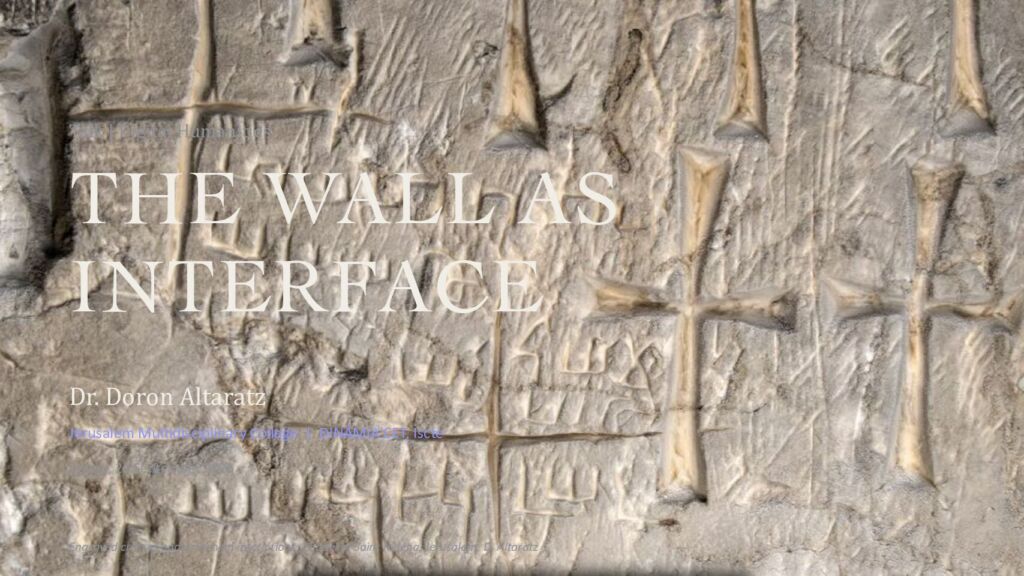
The wall as interface
Digital Humanities talk, Lisbon
A wall is not a static surface. It is a layered archive of human behavior, particular to one place, and it is an interface: it decides what a body may do to it, under whose authority, and what survives.
Read more
The talk follows one question across three places: who sets the rules of the surface? In the Chapel of Saint Helena in Jerusalem, custody is divided between churches. At the Apostolos Andreas Monastery in Cyprus, restoration moves only through a committee of both communities. At the stepwells and mosques of Gujarat and Rajasthan, almost nothing governs how a surface may be recorded.
In each case I ask what the computational surrogate carries over from the wall, and who owns the record and may decide its future.
February 19, 2025
From walls to data: Photographic and computational approaches to graffiti research
NOVA FCSH, Universidade Nova de Lisboa
June 4, 2024
Lo studio dei graffiti dal rilievo all’archeologia sperimentale
Università Ca’ Foscari, Venice
September 11, 2023
Deciphering the engraved crosses in the Holy Sepulchre, Saint Helena Chapel
The Cyprus Institute, Nicosia
Conference presentations
Teaching, research and mobility
At Jerusalem Multidisciplinary College I lead the Department of Photographic Communications, overseeing faculty, student projects and research initiatives, and developing a curriculum that integrates photogrammetry, virtual reality and immersive media. I teach interactive and computational photography, photogrammetry and virtual reality, and supervise undergraduate research and final projects.
Profiles and programs
Faculty page, Jerusalem Multidisciplinary College
Department of Photographic Communication
Associate Researcher profile, DINÂMIA’CET, Iscte, Lisbon
Department of Communication and Journalism, The Hebrew University of Jerusalem
Anant National University, Ahmedabad (visiting faculty, 2023)
DIPTCH 2026, international online course in heritage documentation
October 2026 to January 2027 | Online course, convenor
DIPTCH 2026: Digital Imaging and the Preservation of Tangible Cultural Heritage
An international online course in the Photographic Communication program at Jerusalem Multidisciplinary College: ten sessions, ten speakers.
Read more
DIPTCH 2026 introduces students to the imaging technologies used to document, preserve and share tangible cultural heritage, from aerial and satellite imaging to close-range photogrammetry, 3D scanning, multispectral imaging and microscopic inspection. Each week an international expert presents a technical, theoretical or applied perspective, with case studies from museums, excavation sites, laboratories and national collections.
The speakers are Moshe Caine (Jerusalem Multidisciplinary College, founder of the course), Sharon Tager (The Israel Museum, Jerusalem), Shai Halevi (Israel Antiquities Authority), Sorin Hermon (The Cyprus Institute), Pedro Soares Neves (University of Lisbon), Marinos Ioannides (UNESCO Chair on Digital Cultural Heritage, Cyprus University of Technology), Andrea Tinazzo, Graham Diprose, Stefan Simon and Rolando Volzone (DINÂMIA’CET, Iscte).
The course is taught in English on Zoom, from October 20, 2026 to January 5, 2027. It is a credit-bearing, mandatory second-year course, run in collaboration with the Jerusalem Institute for Research and Digital Documentation of Cultural Heritage.
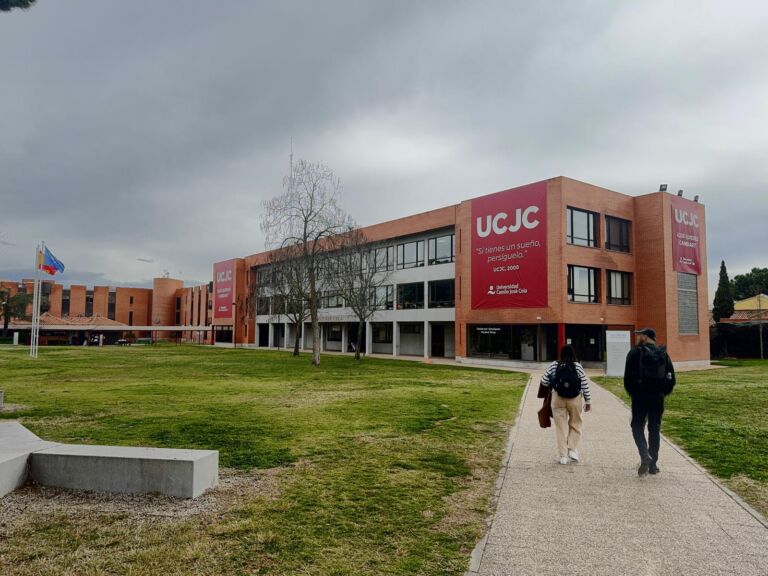
February 2025 | Erasmus+ mobility
Camilo José Cela University, Madrid
Guest lecture in the Department of Communication.
Read more
In February 2025 I taught at Camilo José Cela University (UCJC), Madrid, within an Erasmus+ staff mobility. The program, From Pixels to 3D: Creative Horizons in Photogrammetry, explored photogrammetry in storytelling, advertising and cultural heritage through four sessions of lectures and hands-on workshops: The Art and Science of Photogrammetry; Crafting Visual Narratives with 3D Models; Bringing 3D Models to Life; and Innovating with Photogrammetry in Media and Advertising, where students pitched projects integrating 3D models into media and advertising.
The mobility also served to build partnerships and share teaching practice with colleagues in media and communication.
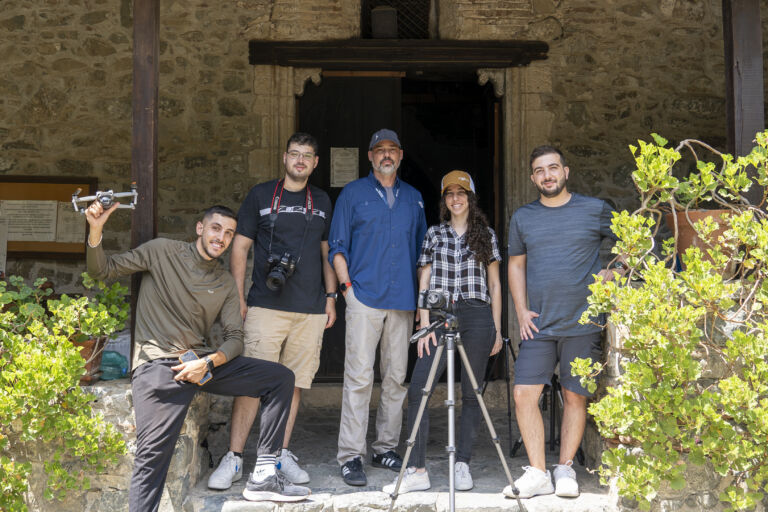
July 2024 | Erasmus+ mobility
The Cyprus Institute, Nicosia
Student and staff mobility at the Science and Technology in Archaeology and Culture Research Center (STARC).
Read more
In July 2024 I led a group of students from the Department of Photographic Communication to the Science and Technology in Archaeology and Culture Research Center (STARC) of The Cyprus Institute, headed by Prof. Sorin Hermon. In the first week, the students, together with STARC researchers, carried out heritage documentation and field survey at the Monastery of Saint John Lampadistis in the Troodos Mountains, part of a UNESCO World Heritage Site. Applying the techniques learned in the third-year course 3D Documentation and Introduction to VR, they captured the site with drones and a laser scanner, data that were then processed into photogrammetric 3D models in the Institute’s computer labs.
Difficult lighting, the architectural complexity of the church and the sanctity of the site required creative, on-the-spot solutions. Beyond their documentation value, the models give the Institute’s archaeologists, historians and architects new means to study the history and function of the building.
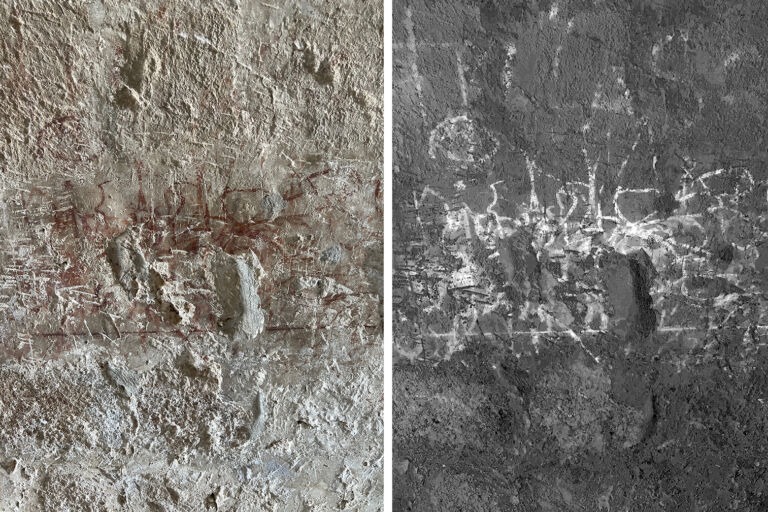
June 2024 | Venice, Italy
VeLA workshop: the study of graffiti, from survey to experimental archaeology
Invited instructor at the VeLA (Venezia Libro Aperto) workshop, Department of Humanities, Ca’ Foscari University of Venice, June 3-7, 2024, within a PRIN project funded by the European Union.
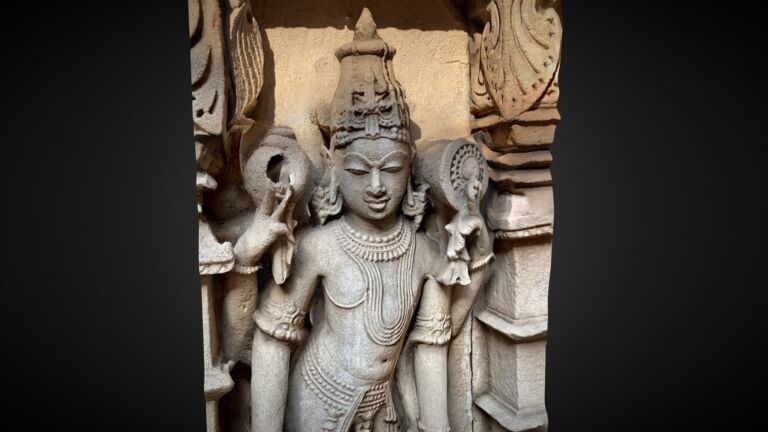
February 2023 | Visiting faculty
Anant National University, Ahmedabad
Guest lecturer in interaction design, leading workshops and research collaborations.
Ongoing | Training, courses and professional workshops
Training and courses, Jerusalem Institute for Research and Digital Documentation of Cultural Heritage
Alongside the college courses, I teach short courses and professional workshops through the Jerusalem Institute for museum curators, conservators, archaeologists and other heritage practitioners, and for members of the public who want to document and preserve local heritage in Jerusalem. The topics include documentation with smartphones, website building, presentations, 3D documentation and preservation methods, and the workshops treat storytelling as a way for communities to keep their heritage alive.
Collaboration, invitations and peer review
For research collaboration, speaking invitations or review requests, I would be glad to hear from you.
doron@altaratz.com | +972 50 221 1436 | ORCID | LinkedIn | CV (PDF)